
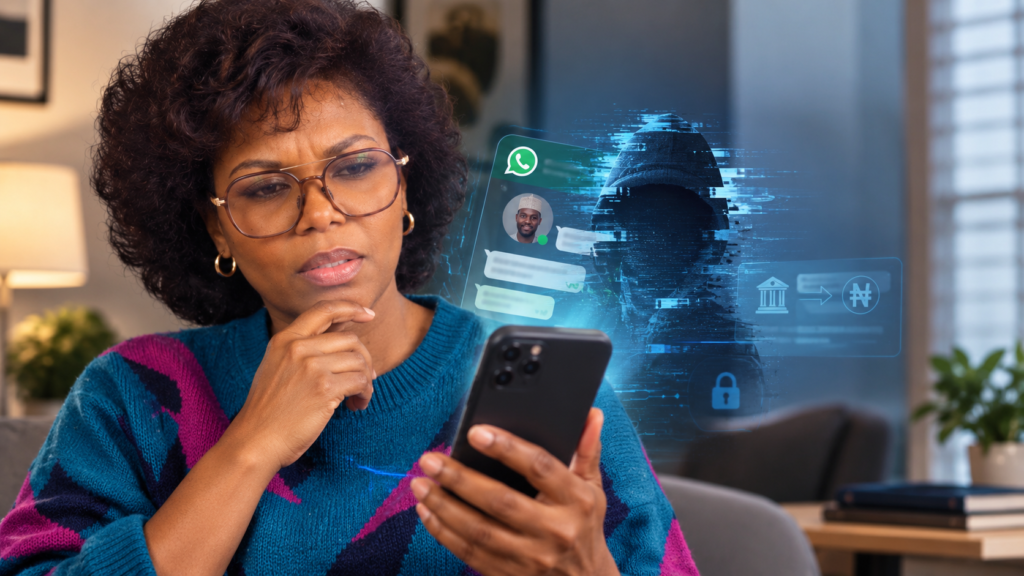
Finally… I’m Back
For a long time, this space had been unusually quiet as some of you must have
noticed. A few of you reached out privately to check on me. Others simply waited
patiently for my next story. It’s indeed a long time to be away. But now I’m back.
To those who checked on me, thank you very much. I value you and do not take
this for granted at all. I must confess, I have also missed this. Sometimes life
demands our attention elsewhere. Sometimes we just need to step back, reflect
and regain perspective.
Ironically, it was during one of those ordinary moments of life that I nearly became
a victim of a scam that would have cost me almost N8million. Yes.. you heard
right.
- Not through a fire.
- Not through a burglary.
- Not through a motor accident.
- Not even through what I would ordinarily describe as a conventional cyberattack.
I almost lost it, because I trusted someone I thought I knew.
It all started like any other day. I was scrolling through my whatsapp when I saw a
message from a familiar face. The elder brother of a childhood friend who is also
a friend. Someone I had known for decades. So when I saw his message, I had
absolutely no reason to suspect anything.
The message said that US$6,000 was available for sale and if interested I should
send him a message, which I did, asking for his rate.
The response came: ₦1,310 to a dollar.
I quickly contacted a friend who might need dollars. She was willing to buy at
₦1,394 to the dollar, against a prevailing rate of about ₦1,400.
For me, nothing looked strange. In fact, the rates made the transaction look
perfectly plausible because there was no ridiculous bargain and no strange link
asking me to click.
It was simply a dollar transaction involving someone I believed I knew.
I had no reason to be suspicious. Or so I thought.
I told the seller that he should transfer the dollars while I arranged for the naira
payment.
He said it had to be the other way round that the dollars were not actually his. He
was helping a friend abroad who urgently needed naira for her mother’s burial.
It sounded plausible. I still did not suspect anything.
My friend (buyer) wanted to see the dollars before sending the Naira, which was
perfectly in order.
I told her: Trust me. “I know this person. He won’t fail me.”
She agreed but asked for a little time to get back to me because she was busy.
I thanked her and appreciated the fact that she trusted me.
And somewhere in that conversation, I was already mentally treating the
transaction as almost completed.
Approximately ₦8 million was about to be transferred.
Then my daughter (my guiding angel) called …
I had missed her earlier calls because I was busy with the transaction.
When we finally spoke, I told her what I was doing.
She listened.
Then she asked:
“Mummy, are you sure about this person?”
I was confident.
Of course I was sure.
I knew this person.
I had known him for years.
Then she asked another question:
“How are you sure this childhood friend of yours will not fail you since you had not interacted in a while?”
I told her there was nothing to worry about.
Then the call ended.
But something happened afterwards.
My instinct took over:
Double-check! Double Check!
So I did.
I called the WhatsApp number on video.
He did not answer.
Suddenly, I became uneasy.
I quickly called his younger brother.
His reaction was instant as if, he was waiting for the call.
“Nooooo!” My brother’s whatsapp account had been hacked.
Ohh. The person I had been communicating with was a scammer.
Suddenly, Everything Made Sense
The scammer had taken on the identity of someone I knew, and in doing so, gained
my trust. Wow.
I immediately called my friend who was to transfer the money.
“Please stop the transaction!”
Thankfully, the money had not been transferred. The approximately ₦8 million was
safe.
Then the scammer sent me another message.
He said he had been in a meeting and had just seen my missed call.
Then he asked calmly with confidence:
“Have you transferred the money?”
By then, I knew exactly who was behind the screen.
I replied:
“YOU ARE A THIEF.”
His response?
Still calmly
“Thank you.”
I could hardly believe it.
That was when it really sank in.
I had almost transferred about ₦8 million to a stranger because I believed I was
dealing with someone I knew. Thankfully, I didn’t.
But the experience left me with one question that I think every smartphone user
should ask: Was this a cyber risk? If the scammer was successful, would my insurance
have responded?
But my phone had not been hacked.
My WhatsApp account had not been hacked.
My bank account had not been hacked.
Nobody had broken into my computer.
I was simply being deceived by someone who had taken over another persons’ WhatsApp account.
That sounds like a scam.
Would insurance pay? Possibly. But not automatically.
That is where the wording of the insurance policy you buy becomes very important.
Some cyber or crime policies can cover losses arising from things such as computer
fraud, unauthorised access, fraudulent transfers or social engineering.
But not every policy covers all of these.
Some may have specific limits.
Some may require particular security measures to have been followed.
Some losses may be excluded altogether.
So the question isn’t simply: “Would Insurance pay?”
The better question is: “What exactly does your cyber insurance cover?”
And That Is the Lesson
Today, our phones are much more than phones.
They are our:
- Offices
- Wallets
- Shops
- Communication centres
- Business platforms and so on
And sometimes, our entire digital identity lives inside them.
A compromised account can therefore become more than an inconvenience.
- It can become a business interruption event.
- A big financial loss.
- A reputational crisis.
- A privacy problem.
- Or even a liability issue.
And that is why I believe cyber risk deserves a much bigger place in our insurance
conversations.
Now Lets look at My Friends’ Risk – The person whose whatsapp account had been
hacked.
This is where the story becomes even more interesting.
My friends’ whatsapp account had actually been compromised.
That is different from my experience.
Suppose the hackers had gone further to gain access to his phone or other
credentials, and had accessed her banking application.
Suppose they transferred money from his bank account without his authorisation.
Would cyber insurance pay? Again, it depends on the policy.
And that “depends” is extremely important.
What does the policy define as a cyber event?
What exclusions apply?
Those details and more can make the difference between an insured and uninsured
risk/loss.
These days, the biggest risk is no longer the physical risk we have always known
such as a fire to your building, an accident to your vehicle or a thief breaking into
your home.
It is that silent, invisible threat that quietly enters your life through your
phone, without you even noticing.
My final question is to both the insurers and the insured: Are we prepared for these new risks?
Don’t wait for the loss to happen before you answer the question.
Check your cyber policy if you have one. Talk to your insurer or broker. Understand
what is covered and what is not.
I’m indeed very glad to be back.
Enjoyed this story?
Get the next one the moment it is published, by email or on WhatsApp.
Email sign-up is being set up.


What you experienced Ma is a mere scam, which I don’t think is covered under cyber security insurance because there was no demand for codes or password to break into your system or bank account.
What it covers:
Cyber attacks
Data breaches
Data incidents.
Thank you, Friday, for visiting and engaging. I’m glad to be back, sharing insights and educating ourselves on risk management and the role of insurance in our everyday lives.
Personally, I don’t think there is a straightforward yes-or-no answer to the question, because insurance coverage is ultimately a function of the policy you have paid for and its terms and conditions.
I agree that many existing cyber insurance policies may not cover scams. However, wouldn’t you agree that scams are a very real and growing risk to which almost everyone is exposed? This makes a strong case for insurers to consider developing appropriate cover, perhaps as an add-on, with clearly defined limits, terms and conditions.
The key message is this: Know what your insurance policy covers and, just as importantly, what it excludes. If there is a risk you want covered, don’t hesitate to ask your insurance provider about the possibility of including it.
Insurance should respond to real-life risks, and conversations like this can help drive that evolution.